

General
First Semester Orientatin Week (ESE)
The First-Semester Orientation Week (ESE) is an event that takes place during the last two weeks before the start of the winter semester. Most students participating are starting the bachelor's, but there are also many events tailored for master's students. New students are introduced to everything they need to know about daily life on campus and, above all, by giving them the opportunity to get to know their fellow students—which is a significant advantage during the first few weeks of school. You can find more information about the ESE here.
Community in the Physics Program
Community in the Physics Program
When studying physics, everyone learns very quickly what it means to fail and what it means to fall short of one’s own expectations. Many of us have experienced what it’s like to be constantly under pressure—whether because of exams, worksheets, or simply the pressure to understand and accomplish everything. Many of us feel overwhelmed, tired, or alone. Many ask themselves, “Am I even good enough for this program?” You’re not alone in this.
What often goes unsaid: It’s normal to feel overwhelmed at times while in college. We all have moments of doubt, feel exhausted, or lose our bearings. Everyone struggles with the same issues, even if it’s not always obvious. That doesn’t make us weak—it makes us human.

Over time, we've learned to cope better with the pressure. We've realized how important it is to take breaks, how helpful it is to talk to others about our worries, and that we can't—and don't have to—do everything on our own.
What sets us physics students apart is community and cooperation. It helps incredibly to work through problems together, explain things to each other, or just vent about all the nonsense together. During stressful times, it can be a huge relief to know: “I’m not alone. We’ll get through this together.” The interactions in study groups, the spontaneous conversations in the cafeteria, or just taking a deep breath together after an exam—all of this helps ensure that college doesn’t become a lonely struggle, but rather a shared journey. A rough semester isn’t the end of the world. It’s totally okay to accept help, whether it’s with the material or just for your mental well-being. Nobody understands everything, and nobody has to. You’re all part of this now. You’re smart, you’re enough, and you always will be—even if it doesn’t feel that way right now, and that’s okay.

Look out for one another.
- “That’s easy,” or as freshmen often like to say, “trivial,” is a statement that’s rarely helpful and usually wrong. If something seems easy, it’s often just that you haven’t understood it well enough yet. You can probably imagine that it’s not pleasant to keep hearing from others that something is “actually so simple” and yet you still don’t understand it. Instead, try saying, “I think I’ve got a pretty good grasp of that. Would you like me to try going over it with you at your own pace?”
- During my first semester, I tried to explain something to a friend. After she left, someone else who had been listening said disparagingly, “She really didn’t understand any of that at all.” Statements like this stem from a great deal of insecurity. You don’t have to stand out from others—you aren’t smarter than them. If you think you understand something better than others, talk to them about it; they’ll be able to explain something else to you that you don’t understand.
What matters isn't whether we do everything perfectly, but that we follow our own path—with curiosity, with consideration for ourselves and others, and with a willingness to take a break now and then. We're glad you're part of this community. You don't have to get through college on your own. We're all in this together, and we've got each other's backs.
Here's to a great start and to a college experience that not only challenges us but also brings us together.
Living in Dresden
Living in Dresden
The student housing facilities operated by the Dresden Studentenwerk offer the best way to live with fellow students, with short commutes to the university and predictable costs. On the Dresden Studentenwerk website, you can search online for the right ⇱Dorm Room. The search function offers various criteria, such as rent and room size, but you can also filter by living arrangements, such as shared apartments for two or single apartments. You can also search for specific types of housing, such as family-friendly or wheelchair-accessible apartments. Be sure to apply for a spot in a dorm as soon as possible.
We highly recommend the programWOMIKO – Wohnen mit Kommilitonen (Living with fellow students). Individual dormitories are assigned to specific departments. If you apply through this program, you’ll have a better chance of getting a spot in a dorm. The Physics department is in the ⇱Wundtstraße 3 which is in very good condition and is very close to the university, various sports facilities, tram and bus stops, and student dining halls. The Wu3 is comparable to the property shown in the following video.
You can find all the information about the dorms—including location, rent, amenities, photos, floor plans, and virtual tours—in the ⇱Dormitory Catalog.
Dresden also has a wide range of private apartments and rooms in shared apartments available. See ⇱dresden.de ⇱wg-gesucht.de. It’s also worth checking out the bulletin boards in the dining halls, the lecture hall complex, or other TU buildings.
Faculty's Student Council (FSR) and Students Council (StuRa)
Faculty's Student Council and Students Council
Information about all other important committees, as well as the university elections, is available at ⇱pfsr.de/hochschulpolitik
The Faculty's Student Council (FSR) is a part of the university-wideStudents council and focuses on specific degree programs: At our university, these include the bachelor’s, master’s, and teacher certification programs in physics, as well as the master’s program in Organic and Molecular Electronics (OME).
One of the Student Council's responsibilities is to improve and shape the degree program within the many different committees. Studiengang in den vielen verschiedenen Gremien zu verbessern und zu gestaltenThe FSR thus serves as the direct link between students and university politicsIt appoints elected representatives to all key committees and ensures the flow of information to students.
Additionaly, we are the first point of contact for students facing any kind of problem. We provide direct advice or refer students to the right places , communicate for you with professors and try to ensure the quality of teaching. The FSR contributes by organizing many events, like ESE (introductory week), the Feuerzangenbowle (a kind of pre-christmas christmas party), music nights, creative nights, or game nights, and much more significantly to the culture and life at the faculty . One of our most important tasks is Equal Opportunities Work.
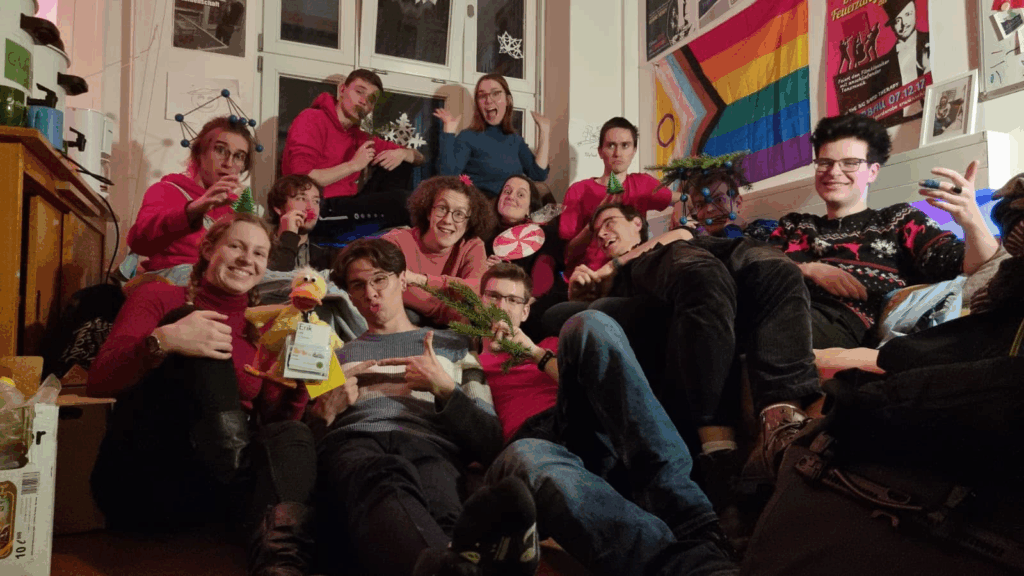
In parts, the FSR consists of elected members,which are elected by all students of the faculty once every year during the university elections. Additionally, non-elected members, so-called associates, contribute no less to the FSR work. However, they do not have the possibility to vote for resolutions or to hold the position of speaker or financier. For other things, such as representing the FSR in a body (e.g. Student Council), one does not have to be an elected member of the FSR, as the mandate is transferred by delegation.
At events, you can often recognize us by our red sweaters, sprecht uns gerne anIf you have any questions, feel free to contact us or simply stop by our office.
Office: ⚐ ⇱REC/D017 (Campus Navigator)
Phone: ✆ +49 351 463-34788
E-Mail: ✉ ⇱fsrphysik@tu-dresden.de
Instagram: ⇱@pfsr_tud
You can find our office hourshere During the semester, we hold a weekly public general meeting. It currently takes place every Monday starting at 7 p.m. .
The ⇱Students coucil(StuRa) is the university-wide committee of the student body. Accordingly, it advocates for students on the level of the university or the city. In addition to the FSRs, the StuRa also supports projects by the nearly ninety ⇱University groups, which have a large influence on the public life at the university and in Dresden , for example theCampus Radio, ⇱Fridays For Future Dresden, Studis Against The Right Dresden, student-run clubs like our favourite club ⇱HängeMathe, the ⇱Uni Orchestra and many more. With manycounseling services , the StuRa supports you while you study. Additionally, it is for example responsible for your semester pass.
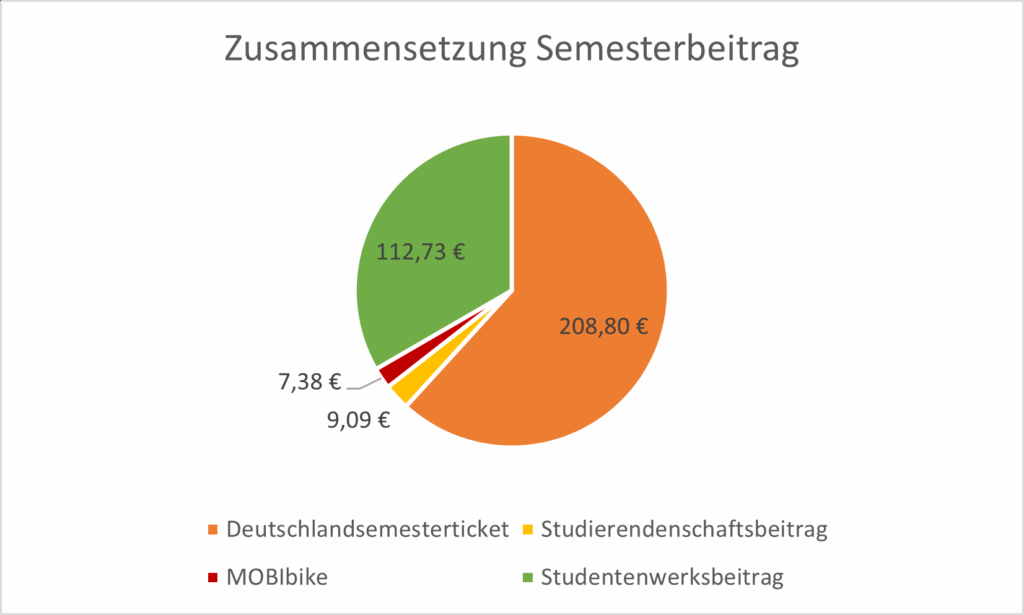
Stura and FSR are financed by your semester contribution. Volunteer work on university committees qualifies you for extensions to the standard period of study, which allow you, for example, to continue receiving BAFöG or remain covered under family health insurance. AQua kann man sich die Tätigkeit in FSR, StuRa oder Studienkommission anrechnen lassen.
Semester Ticket and MOBI Bikes
Semester Ticket and MOBI Bikes
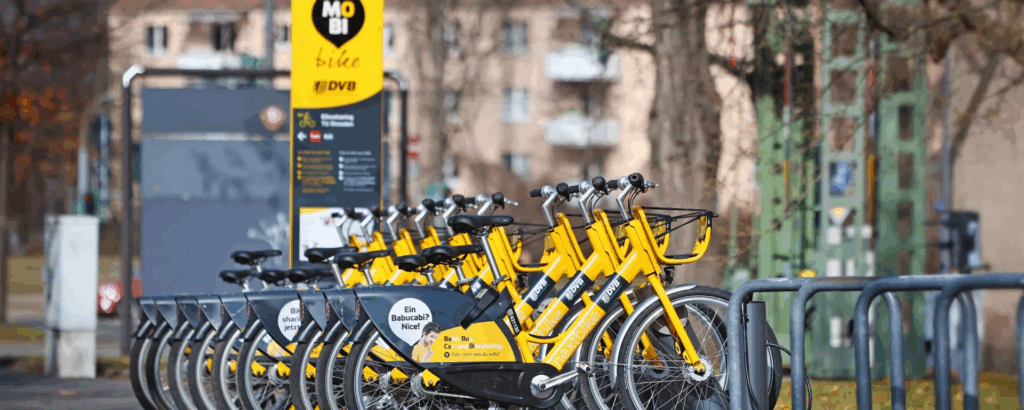
You can retrieve your Deutschland-Semesterticket ⇱here . The ticket is valid throughout Germany on buses, ferries, and streetcars, as well as on regional transit (as a Deutschlandticket). You can also use the rental bicycles of ⇱Nextbike (in Dresden, Freital and Heidenau as yellow bikes branded MOBIbike) in all of Germany for free for 30 minutes per rental, as well as MOBI cargo bikesLastenräderin Dresden for free for 30 minutes per rental. You'll receive extra free minutes for parking in certain designated zones. The Deutschland-Semesterticket does not include free transport of dogs or bikes. enthalten.
The Semesterticket is issued as a Barcode . This Barcode is valid during a control only when presented along with a valid ID. als Fahrausweis gültigYou can export the barcode to the Apple Wallet or Google Wallet apps, making it available offline. You can also download it as a .pkpass file, which can be imported into other apps (e.g., PassAndroid). Prices and conditions of this ticket are negotiated by the ⇱Mobility Department of the StuRa.
Curriculum and Standard Duration of Study (only translated for Master yet)
Curriculum and Standard Duration of Study (only translated for Master yet)
Bachelor (BSc)
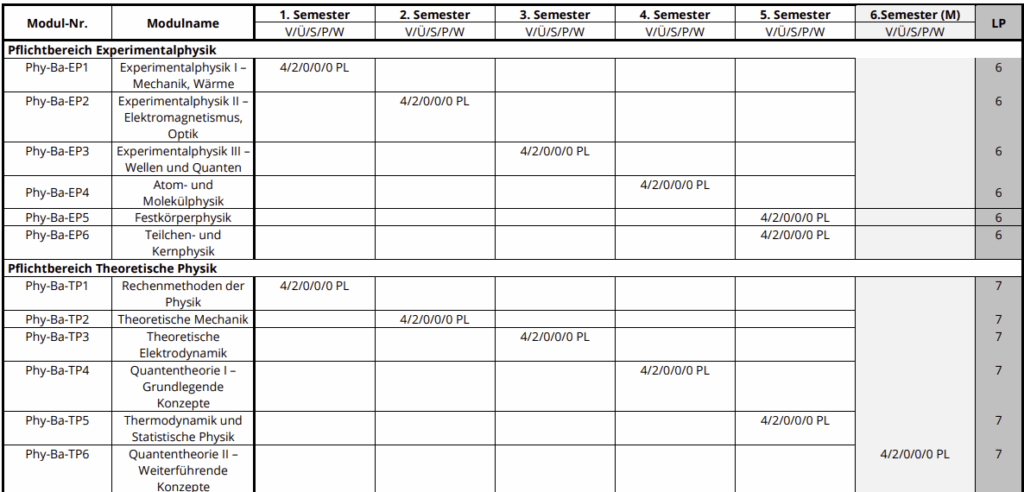
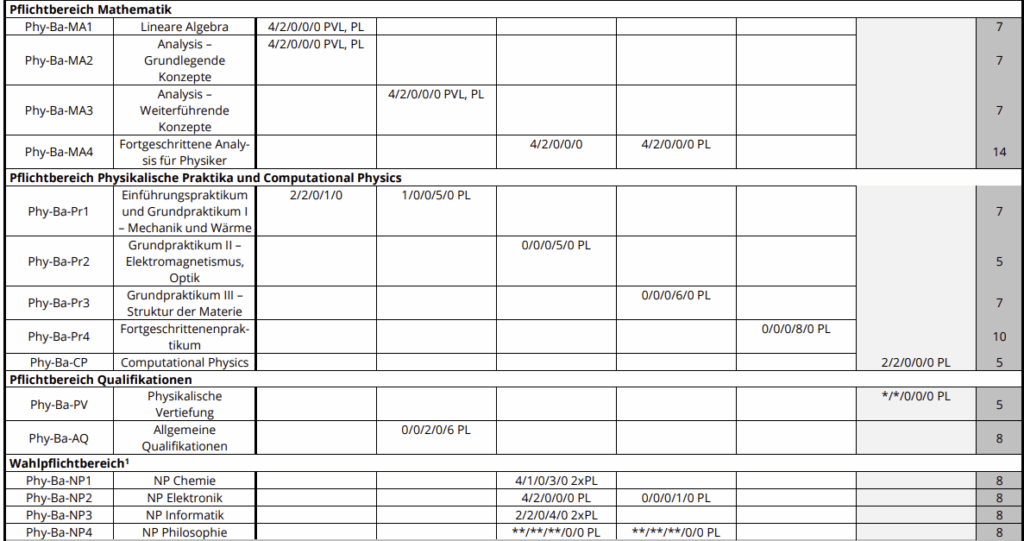

Das Bachelor-Studium lässt sich im wesentlichen in fünf Bereiche unterteilen: Mathematik, Theoretische Physik, die Experimentalphysik, das physikalische Praktikum und den Wahlpflichtbereich sowie „AQua“ (Allgemeine Qualifikationen). In der theoretischen Physik werdet ihr die mathematischen Methoden anwenden, welche ihr in den ersten Semestern lernt, um allgemeine Strukturen und physikalische Gesetze in unserer Welt zu finden. Ihr werdet diese Gesetze systematisch untersuchen und lernen, Vorhersagen zu treffen. Die Experimentalphysik beschäftigt sich mit der Untersuchung, Messung und Anwendung physikalischer Phänomene. Im physikalischen Praktikum werdet ihr neben der Durchführung und Protokollierung von Messungen auch die statistische Datenauswertung lernen. Den Wahlpflichtbereich könnt ihr euch später aussuchen, das spielt im ersten Semester noch keine Rolle. Im Modul „AQua“ oder „Allgemeine Qualifikationen“ könnt ihr euch so ziemlich alles anrechnen lassen, von ehrenamtlicher Arbeit über Sprachkurse bis hin zu Sportkursen.
Im ersten Semester startet ihr mit den Modulen Lineare Algebra, Analysis 1 – Grundlegende Konzepte, Rechenmethoden der Physik, Experimentalphysik 1 – Mechanik und Wärmelehre and the physikalischen Einführungspraktikum. Grundsätzlich ist der Studienplan nicht fest, sondern ein Vorschlag. Es empfiehlt sich allerdings, die Module in der vorgesehenen Reihenfolge zu hören, da stets auf Kenntnissen aus den vorhergehenden Module aufgebaut wird.
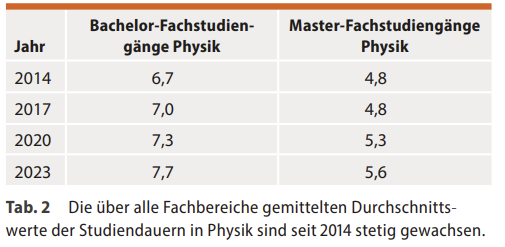
Note: Im Jahr 2023 lag bei gerade einmal zwei der 36 Physikstudiengängen in Deutschland (mit mehr als fünf Abschlüssen pro Jahr) die Median-Studiendauer bei sechs Semestern. Die sogenannte „Regelstudienzeit“ ist also keine Regel, sondern wird meist deutlich überschritten, an deutschen Unis im Schnitt um etwa ein Jahr. Mehr Infos dazu könnt ihr ⇱here finden.
Es ist gängig, dass Menschen eines der Module aus dem ersten Semester ein Jahr aufschieben, da der Arbeitsaufwand sonst zu hoch sein kann. Manchmal besteht man im ersten Semester eines oder mehrere Module nicht, das ist völlig normal, auch dann kann es sich lohnen, Module zu wiederholen. Ihr müsst einen Weg finden, der zu euch passt und bei dem ihr vor allem gesund bleibt. Es empfiehlt sich erst einmal, mit allen Modulen zu beginnen, und dann zu entscheiden.
Module bestehen meist aus Vorlesungen und Übungen. Im Studienplan könnt Ihr z.B. ablesen, dass das Modul „Rechenmethoden der Physik“ aus vier Vorlesungseinheiten (zwei Vorlesungen zu je 90 Minuten), in denen Ihr neuen Stoff behandelt (vorgelesen bekommt) pro Woche besteht. Dazu kommen jede Woche zwei Übungseinheiten (eine Übung mit 90 Minuten), in denen ihr Übungsblätter besprecht.
Note: Manche Lesende bieten zusätzlich zu den offiziellen Inhalten noch eine sogenannte „fakultative Zusatzvorlesung“ an. In diese Vorlesungen wird häufig der Stoff erneut durchgekaut oder vertieft. Es dürfen allerdings keinesfalls prüfungsrelevante neue Inhalte eingeführt werden. Insbesondere das erste Semester ist bereits ohne diese Zusatzvorlesungen so voll, dass ihr euch ganz genau überlegen solltet, ob ihr das wirklich braucht. Passt hier auf Gruppenzwang auf, also nur weil Freund*innen die Lesung besuchen, heißt das nicht, dass ihr das auch tun solltet. Achtet auf eure Zeit!
Zählt man alle Module zusammen, dann kommt man (ohne Zusatzvorlesungen) in der Woche auf etwa 21 Stunden für Vorlesungen und Übungen. Ihr solltet definitiv nicht die Menge des Stoffes unterschätzen. Ihr werdet im Studium in wenigen Wochen mehr neues lernen müssen als in eurer gesamten Schulzeit. Das ist allerdings nicht alles! Anders als in der Schule geschieht der Großteil der Arbeit eigenständig, beziehungsweise im Team mit anderen Studierenden. In den meisten Modulen bekommt Ihr jede Woche ein Blatt voller schwieriger Aufgaben. In den Mathematik Modulen müsst ihr derzeit diese Aufgaben abgeben und eine gewisse Punktzahl erreichen um zur Prüfung zugelassen zu werden. Hier eine Beispielaufgabe aus dem Modul Analysis 1:
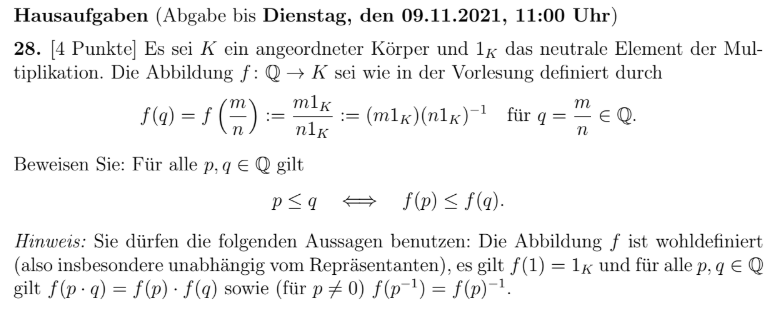
Auch generell ist es enorm wichtig, die Aufgaben zu bearbeiten. Die meisten Studierenden würden sogar sagen, dass es deutlich wichtiger ist, die Aufgaben zu bearbeiten, als die Vorlesungen zu besuchen, denn nur durch aktives Anwenden lernt man tatsächlich etwas dazu. Mit dem Selbststudium kommt man dann leicht auf 50+ Arbeitsstunden pro Woche.
Note: Achtet unbedingt auf Eure Gesundheit! Es ist wichtig, rauszugehen, Sport zu treiben, gesund und genug zu essen und ausgiebige Pausen zu machen, sonst werdet Ihr nicht nur ineffizient beim Lernen, sondern auch sehr schnell krank. Wenn man das erste Mal vor einer solchen Aufgabe sitzt, dann wird einem schnell klar, dass man das nicht alleine schafft, insbesondere da es jede Woche vielleicht 50 davon gibt. Häufig sitzen Studis stundenlang an einer einzelnen Aufgabe. Es ist ganz wichtig zu wissen, dass das völlig normal ist. Du bist klug genug! Arbeitet unbedingt zusammen an den Aufgaben, Physik war schon immer und ist auch heute noch eine gemeinsame Leistung. Ihr lernt besser, wenn ihr Ideen mit Anderen besprecht, als wenn ihr ewig gegen eine Wand rennt, weil euch der notwendige Trick nicht einfällt.
Master (M.Sc.) [under construction]
The master’s program “Physics” builds on the foundations of the bachelor’s program and is (almost) entirely in English. It is divided into two phases:
In the first year, you will attend classes and take the corresponding module exams: Experimental Physics, Theoretical Physics, Specialization Physics, Advanced Scientific Seminar, Non-physics Supplementary. The Experimental, Theoretical, and Specialization Physics exams are oral exams, each lasting 45 minutes, and the Advanced Scientific Seminar consists of a presentation in English (30 minutes + 15 minutes for questions). The language of instruction is english, and students can generally choose the language of the exam. The format of the Non-Physics Supplementary exam depends on the specific module description and can therefore vary greatly . The language of instruction can vary depending on the chosen subject between English and German. Thus, especially for English-speaking students, it is important to review the module descriptions!
In the second year , you have only two modules: Scientific Studies and the master’s thesis. You’ll choose one of the research groups in advance where you want to complete your Scientific Studies, and you’ll generally stay with the same topic and the same research group for your master’s thesis as well. You’ll complete Scientific Studies with a presentation (30 min + 15 min for questions), and after the final module exam (usually Scientific Studies), you must register your master’s thesis within one month. Unlike with the bachelor’s thesis, you don't have to defend it.
Places to study
Places to study
There are many ways to get help with your studies at the university—especially in physics and mathematics. Two main places to turn to are the Physics Tutorial Center (Lernraum Physik) and the Mathematics Tutorial Center (Lernraum Mathematik), which offer you regular support. The Physics Study Group takes place during the lecture period Monday through Thursday from 4:30 p.m. to 7:00 p.m. at Room ⚐ ⇱REC/D016 (Campus Navigator), directly across from the FSR office. Opening hours may vary slightly during exam periods. Here, you have the opportunity to ask questions, delve deeper into the material, and study with others.
The Mathematics Tutorial Center is currently open Mondays from 5:00 p.m. to 8:00 p.m. and Wednesdays from 3:00 p.m. to 6:00 p.m. at Room WIL/A221 - both during the semester and during exam periods.

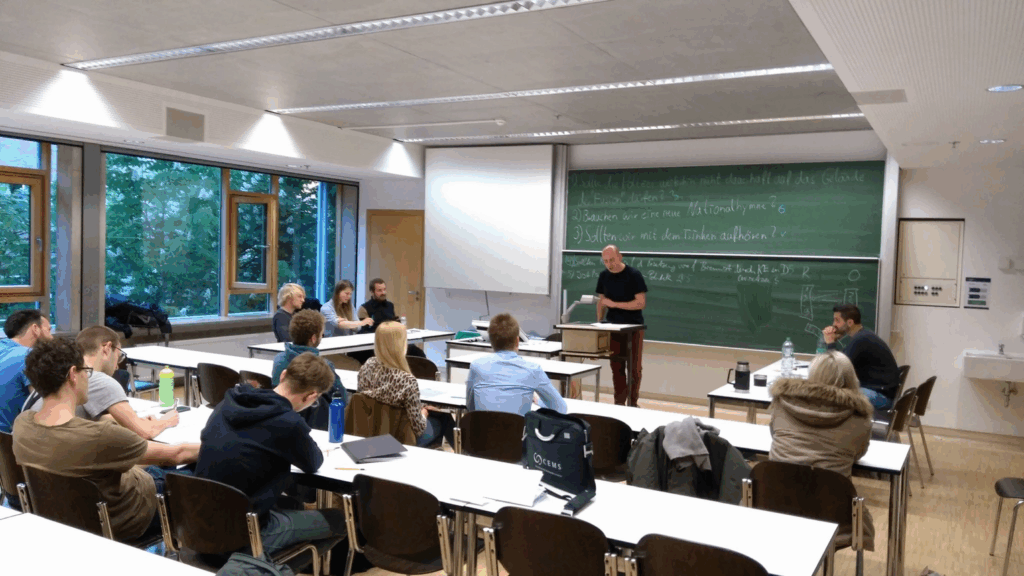
In the tutorial centers, you get help with exercises and homework, you can review lecture material at your own pace or focus on preparing for exams. No registration is required—just stop by!
But even beyond these scheduled offerings, there are many opportunities to study on campus. For example, if you’d like to review course material in peace or meet up with fellow students to work on practice sheets together or prepare for an internship, it’s worth checking out the available seminar rooms or lecture halls. Especially in the HSZ you can often already tell from the outside which rooms are currently available. In the Willersbau there are places to sit and blackboards in the hallways. To access the two PC-Pools in the Recknagelbau, you'll need to visit the office of Jens Brose to activate your student ID card—one of the rooms even has a grand piano for practice.
For a relaxed learning environment—or just a quick break in between— , the so called "Kuschelecke" ⚐ ⇱(Room REC D 103) is also great. You can get the door code at the FSR office upon request.
Selma and Opal
Selma and Opal
Parts of the digital studying management at the TU Dresden are organized via the platform ⇱OPAL, some others via ⇱selma. As a rule of thumb: The "official stuff", like registration and withdrawal for exams, lectures, and seminars, as well as your grades and study documents can be managed via selma. The communication with your professors and tutors (especially exercise sheets) takes place mostly via the corresponding Opal courses .


To log in to these portals, you'll first have to ⇱set up your ZIH-Login. You should have gotten the neccessary information via E-Mail. For accessing Opal, you additionally have to visit the ⇱Self-Service-Portal to initialize the Two-Factor Authentication. You can find a kind of tutorial on setting up the 2FAhere finden.
For each of your courses (both lectures and associated seminars), you should register both on Selma and in the corresponding OPAL course. In later semesters and the Master, the process may differ for some courses.
You can find a detailed guide on how to register here (in German):
Software, Internet, and Digital Tools at TUD
Software, Internet, and Digital Tools at TUD
Almost everywhere at TU Dresden, as well as at many other universities and research institutions around the world, you can use eduroam to access the internet via free WiFi. You can find setup instructions ⇱here.
As a student at TU Dresden, you receive your own mail adress. You can access your e-mail account either viamsx.tu-dresden.de using your ZIH login and two-factor authentication, or via Microsoft Outlook, which you (as well as other Microsoft Office programs) can get for free via the university. Instructions can be found ⇱here. Your TU email is the primary way for professors, tutors, and the administration to contact you, so be sure to check your inbox regularly. System messages from Opal and Selma are also forwarded to this address. About once a month, you’ll also receive the Newsletter of the Physics Student Council, which keeps you up to date on the most important events and news.
Note: You can set up email forwarding to the email account you normally use. You just need to make sure to always send emails related to university matters through your university email account. If you try to use a non-university email address for university-related communication, messages will usually end up in the spam folder and won't reach their destination.
If you're not a fan of the formatting in Word or LibreOffice, it might be worth it for you to learn ⇱LaTeX on your own, even though it is not required as part of the degree program. Most academic papers are written in this way. TU Dresden offers ⇱its own platform based on Overleaf, where multiple people can edit LaTex documents at the same time.
The following tools might also help you for your studies:
- ⇱WolframAlpha especially for tricky integrals
- ⇱GeoGebra – free graphic calculator
SLUB – Library and Books
SLUB – Library and Books
The ⇱SLUB is the university library of Dresden. The most relevant of the six ⇱locations for you is the ⇱central library close to the Trefftzbau. There you'll find an excellent selection of specialized literature on physics and other subjects, some entertainment media, sheet music, the ⇱Library of Things, and much more. Outside of exam periods, you'll also have a good chance there if you're looking for a quiet place to study. You can reserve seminar rooms in the SLUB for working in groups for free online. The SLUB is also open on weekends.

Currently, you're not allowed to take backpacks or bags with you: therefore, you should always have a spare 1- or 2-Euro-coin ready for the lockers . If you want to lend books, you'll have to register first with your ⇱TU-Login . You can then use your designated SLUB password and your campus card to check out materials at the self-checkout machines.
Note: Don't be confused: There are separate SLUB cards for non-TU people, so the process works a little differently for them.
The SLUB also has a lot of digital offers: On the SLUB Website, you can also lend E-Books You can get the most important books you'll need for your studies for free as a PDF via the Website of ⇱Springer Nature To do this, you must either be connected to the campus Wi-Fi network eduroam (see the chapter “Software, Internet, and Digital Tools at TUD”), use a ⇱VPN connection the „Institutional Login“ with your SLUB account. Important note regarding the latter: Your institution is the SLUB Dresden, not the TU. You can also acess some scientific journals as well as the press database ⇱wiso in this way.
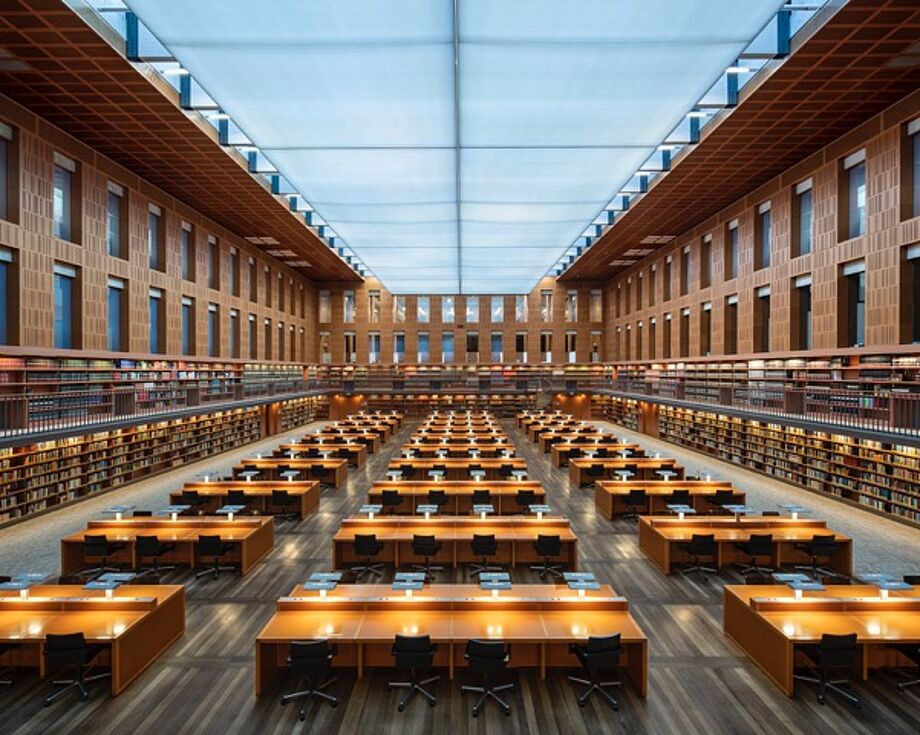
Note: For your studies, you'll generally need no additional books,, so don’t buy them unless you really want to. If you do prefer the print version and absolutely want to work with books, we have the relevant books for the bachelor’s program and more—not only at the SLUB, but also in our office or in the "Kuschelecke" room (see the chapter “Places to Study”). Usually, just a quick look at Wikipedia, YouTube or lecture notes from other universities, which you can find by simply googling, can be enough.
Finding student jobs
Finding student jobs
For the vast majority of students, the topic of study financing is a sensitive one. If you don't get (enough) BaFöG , a solution might be to work while studying. zu gehen. Wie ihr vielleicht schon mitbekommen habt, ist das erste Semester in der Physik sehr sehr voll und es ist empfehlenswert sich – wenn möglich – das erste Jahr, zumindest aber das erste Semester nur aufs Studium zu konzentrieren. Es geht im ersten Semester nicht nur ums Studium: Viele wohnen das erste Mal nicht mehr zu Hause, man muss ein neues soziales Umfeld navigieren und sich an der Universität zurechtfinden.
Note: Since the first semester is often especially tricky - for many international students it's the first time abroad and there is a new social environment, language, visa problems etc. - depending on your financial situation it might be a good idea to start working only after the first semester..
Dresden is a city with a large student population, so there are plenty of part-time job opportunities even outside the university. Depending on your preferences, it’s a good idea to look for student assistant positions (SHKs) at the university. These jobs offer a wide range of weekly hours, pay well, and are usually located right on campus, so you won’t have far to go. In later bachelor semesters or the master, you can grade homework, teach math or physics study groups, or answer questions in the physics study room.
Job openings for students are also collected by the Student Employment Service(STAV) Job openings submitted to the FSR are usually posted by us as well (Service tab → Job Postings)
University Life and Leisure Time
University Life and Leisure Time
In addition to your studies, it’s really important to find a balance to your studies so you don’t just end up staring at worksheets and slowly gathering dust. Luckily, the university and the city offer an almost endless array of options. There are over a hundred University groups with exciting opportunities. Whether you're interested in art, culture, music, sports, politics, religion, technology, or business, there's something for you! You can find a detailed list of the university groups and what they stand for is ⇱here. Bachelor students can use these for their AQua module .
Note: The Faculty's Student Council and StuRa are also in urgent need of people with all kinds of talents—and it’s actually fun (: (yes, of course we might not be 100% impartial here). Just drop by the meeting on Monday at 7 p.m. at the FSR office. For more information, see the “Faculty's Student Council and Student Council” section.
Exam preparation
– WIP –
At ⇱klausurnoug.at (successor to klausurschokola.de) or the associated physics forumphysik.protagon.space you'll find past exams (mostly Bachelor) and transcripts of oral exams.
Note: If you're having trouble signing up for the Physics Forum, remember that your email address ends in @mailbox.tu-dresden.de.
In many exams in the bachelor (especially Experimental Physics and Theoretical Physics), you are allowed to use a handwritten A4 sheet of paper. Examples of these are available for all courses at the FSR office.
In general, especially for exam preparation, it’s better to study with others than alone. For exams in the bachelor, most people set aside 1–2 weeks beforehand and then, depending on how confident they feel and the subject, work through a mix of past exams and practice problems. Since you’ve already done the practice problems before, you can easily get through 2–4 sheets a day.
The tutorial center is also open during the main exam period, though with modified hours.
Exams
When are the deadlines for exam registration?
You can find the deadlines for exam registration for the current semester here.
What can I do if I cannot take an exam due to illness, negative circumstances or if I would be at a disadvantage?
If it is not possible to take examinations in the prescribed form due to a physical disability or chronic illness or the care of relatives (including the care of children), it is possible to apply for compensation for a disadvantage. This can then mean, for example, extended working hours or an adapted examination format.
How do I withdraw from an exam due to illness?
If you become ill, you should first notify your examiner and then inform the Office of Academic Examinations. Then you let your doctor fill out this form . In the case of multiple exam withdrawals due to illness, you'll need to let them fill out an additional form .
In any case, you must always fill out this withdrawal form yourself.
What kinds of exam formats are there?
The new examination regulations mention known but also new formats for exams. Here is a brief overview:
| Klausurarbeiten | Die Dauer ist den Modulbeschreibungen zu entnehmen, darf aber eine Dauer von 60 Minuten nicht unter bzw. 360 Minuten nicht überschreiten.Hausarbeiten |
| Hausarbeiten | auch als Gruppenleistung möglich, wenn Einzelbeiträge deutlich erkennbar sind Der zeitliche Umfang darf 300 Stunden nicht überschreiten |
| Mündliche PL | Dauer von 10 bis 75 Minuten pro Person In einer Gruppenprüfung können maximal fünf Person parallel geprüft werden Prüfung muss immer vor mindestens zwei Personen (zwei Püfer*innen oder Prüfer*inn sowie sachkundige Beisitzer*in) abgelegt werden Können auch öffentlich durchgeführt werden Wenn Einverständnis von Prüfer*innen und geprüfter Person, Beisitz vor eigener Prüfung erlaubt |
| Komplexe Leistungen | sowohl Präsenz- und Nichtpräsenzleistungen möglich auch als Gruppenleistung möglich, wenn Einzelbeiträge deutlich erkennbar sind Der zeitliche Umfang darf 450 Stunden nicht überschreiten |
| Portfolio | Zusammenstellung gleich- oder verschiedednartiger Einzelleistungen auch als Gruppenleistung möglich, wenn Einzelbeiträge deutlich erkennbar sind Der zeitliche Umfang darf 300 Stunden nicht überschreiten |
| Wissenschaftlich-praktische Leistungen | Es handelt sich um nicht gegenständliche Präsenzprüfungen, bei denen die Handlungen der Studierenden im Fokus stehen Dauer von 15 bis 45 Minuten |
| Sprachprüfungen | dient zum Nachweis sprach praktischer Fähigkeiten sowohl als schriftliche als auch mündliche Einzelleistung durchführbar Dauer von 15 bis 240 Minuten |
| Elektronische Prüfungen | müssen dem allgemein anerkannten Stand der Technik entsprechen |
How is the final grade of the BA Physics composed?
Examination performances which are a prerequisite for the continuation of studies (in particular the last repeat examination) must be assessed by two examiners.
One of the six module grades can be deleted from the area grades Experimental Physics and Theoretical Physics. For this purpose, a declaration with the module to be deleted must be given to the examination office.
This is how the final grade is formed:
| Teilberich | Anteil an Gesamtnote/% |
|---|---|
| Experimentalphysik | 25 |
| Theoretische Physik | 25 |
| Praktika und Computational Physics | 20 |
| Wahlpflichtbereich | 5 |
| Bachelorarbeit und Kolloquium | 10 (wobei 5/6 Arbeit und 1/6 Kolloquium) |
In what time frames do exam results have to be announced?
- oral exam: immediately after the exam
- written Exam: 4 weeks
- written exam with more then 300 participants: 8 weeks
What can I do about discrepancies in exam grading?
Upon request, the examiner must give new reasons for the assessment, whereby a deterioration of the result is excluded. Here it is very important that you have the right to inspect the examination documents and may even request a copy.
Can I be disqualified from a passed exam due to cheating?
Yes, this can happen even after the results have been announced. If the unlawful taking of the exam was intentionally obtained by the student, the exam can only be considered as "failed" if requirements for taking the exam were not met.
When is a module considered passed?
The module grade must be at least “satisfactory” (4.0). This also means that it is possible to pass even if individual grades for the module were rated “unsatisfactory” (5.0), since the overall grade is an average of all individual grades. Please note: While this may apply to some practical courses, it’s always important to check whether obtaining individual grades is mandatory.
When is a module finally considered not passed?
Within one year after the announcement of the first-time failure of a module examination, the student should participate in a first retake examination. At the end of the year, the first repeat attempt is forfeited. If the student fails again, the examination should be repeated a second time at the next possible date. In the case of a renewed failure, it is considered to have been definitively failed. Exceptions are the modules from the areas of experimental physics and theoretical physics, these can also be repeated a third time.
If the module examination consists of selectable individual examinations (this is the case, for example, with the advanced lab course), one is not bound to these individual examinations after failing them, but can make a new choice.
Can I have credits for studies and examinations from other universities, fields of study or qualifications acquired outside of a university credited to me?
Yes, this is possible in principle, unless there are significant differences between the qualifications acquired. The required documents must be submitted to the examination board, from which time the crediting procedure may not exceed the duration of two months.
Do I have to be notified in writing of any onerous decisions?
No, under the new examination regulations, this can also be done electronically.
Can I attend a meeting of the exam committee?
Yes, guests may be admitted to meetings in special cases.
How do I opt out of an exam?
The student must register for the performance of examinations.
A later deregistration is possible without giving reasons. The form and deadline for registration and deregistration are determined by the Examination Committee and announced at the beginning of each semester as is customary in the faculty. This also applies to preliminary examinations.
Counseling Services
Eine Übersicht der Beratungsangebote der TU Dresden ist here .
Studying with a Disability or Chronic Illness
The coordinators for students with disabilities and chronic illnesses support you in choosing and applying for a degree program, organizing your studies, and completing your degree. They offer personalized counseling on accommodations for coursework and exams, digital and physical accessibility, and support options for everyday student life.
Ausführliche Informationen sind here .
Tutor:innen
Ihr habt eine SHK / WHK in der Physik oder Mathe? Ihr gebt eine Übung oder unterweist Studierende im Praktikum? Und ihr wollt wissen, wie man so etwas eigentlich richtig macht? Dann seid Ihr bei TUTORING hybrid richtig. Dieses Programm am Zentrum für interdisziplinäres Lehren und Lernen (ZiLL) bietet viele Qualifizierungsmöglichkeiten für Fachtutorinnen und Fachtutoren. Schaut hierfür gerne auf der Website des Programms vorbei, schreibt Euch für ein Angebot auf OPAL ein oder abonniert den Newsletter von TUTORING hybrid.
Eine Übersicht findet Ihr here.
Erstakademiker:innen
Insbesondere für Erstakademiker:innen, also Studierende, die als Erste in ihrer Familie ein Studium anfangen oder anstreben, gibt es mit P.E.A.C.H., der Plattform für Erstakademiker:innen zum Checken der Hochschule, ausführliche Infos, Tipps und Tricks zu Studium, Finanzen, Wohnen und Lernen in Dresden. Link: https://tu-dresden.de/tu-dresden/universitaetskultur/diversitaet-inklusion/diversity-an-der-tu-dresden/p-e-a-c-h-plattform-fuer-erstakademiker-innen-zum-checken-der-hochschule-1